Resource · Wildfire HO
FAIR Plan vs. private coverage
What FAIR actually covers, what it doesn't, and how to think about the trade-off.
For: Homeowners weighing the trade-offs
By Tyler Chalk · Published May 21, 2026 · Updated July 27, 2026
“Just use the FAIR Plan” is something a lot of California homeowners hear, often from people who haven’t read what the FAIR Plan actually covers. It’s a real and important market, sometimes the right answer, but it’s almost never a complete answer by itself. Here’s the honest version.
What the FAIR Plan is
The California FAIR Plan Association is the state’s insurer of last resort. It was created in 1968 to provide basic fire coverage to property owners who couldn’t get insurance in the standard market. It’s not a state agency. It’s a joint insurance pool that all admitted carriers in California are required to participate in. The carriers fund it; the carriers also share its losses.
Because FAIR is the last-resort market, the price is generally higher than admitted-market pricing for a comparable risk, and the coverage is much narrower.
What the FAIR Plan covers
The FAIR Plan’s standard dwelling policy is a basic fire policy. It covers:
- Fire
- Lightning
- Internal explosion
- Smoke (from a hostile fire)
- A few additional named perils available by endorsement, including (depending on your policy form) windstorm, hail, vandalism, theft of building materials, and limited water
The FAIR Plan has added optional endorsements over time, but the base policy remains narrow.
What the FAIR Plan does NOT cover
This is the part that surprises people. The FAIR Plan typically does not include:
- Liability: if someone slips on your driveway, FAIR doesn’t pay.
- Theft of personal property (in most forms, read your policy)
- Water damage from burst pipes, appliance leaks, etc.
- Loss of use / additional living expenses beyond limited amounts
- Personal property at full replacement cost (often capped or settled on actual cash value)
- Many of the optional coverages that come standard on a real HO policy (identity theft, sewer backup, refrigerator/freezer contents, etc.)
If you only have a FAIR Plan policy, a kitchen-faucet leak that destroys your floors is not covered. A guest tripping on your porch and breaking a hip is not covered. A burglary while you’re traveling, not covered. This is why FAIR by itself is rarely the right answer.
The DIC wrap: closing the gap
A Difference-in-Conditions (“DIC”) policy is a private-market policy designed to layer on top of a FAIR Plan policy. The DIC fills in the perils and coverages FAIR doesn’t include: liability, theft, water damage, loss of use, often broader personal property, and the typical HO bells and whistles.
Stacked together, FAIR + DIC gives you something close to (but not identical to) a standard HO-3 policy. The “not identical” part matters: the policies are independent, with separate deductibles, separate claim processes, and a coordination layer that has to be read carefully so coverage isn’t accidentally missing in the seams.
DIC carriers vary in appetite. Some won’t write DICs over FAIR for homes above a certain replacement-cost threshold; some won’t write DICs at all for homes in the highest fire-hazard zones; some have specific construction or roof-age requirements. There is no single best DIC market; the right one depends on the home.
FAIR + DIC vs. specialty surplus-lines
For wildfire-exposed California homes, the two main alternatives to no coverage are usually:
- FAIR Plan + DIC wrap, as described above.
- A specialty surplus-lines homeowners policy: a single non-admitted policy that covers the home the way a standard HO would, from a carrier purpose-built for wildfire exposure (the Stand Insurance Solutions program is one example; others exist).
When the specialty surplus-lines path is available for your home, it’s usually simpler and easier to manage: one policy, one carrier, one renewal. When it isn’t available (or quotes too high), FAIR + DIC is often the answer.
Why one path or the other?
- FAIR + DIC tends to make sense when: specialty surplus-lines markets decline the home; the home is in the highest-hazard zones; the homeowner needs to stand up coverage fast and FAIR is the only market that will issue immediately; or the math just works out cheaper for the specific home.
- Specialty surplus-lines tends to make sense when: the home qualifies; the homeowner values a single-policy experience; the home has been hardened and that hardening matters to underwriting; or the FAIR + DIC stacked premium is higher than a single-carrier surplus-lines quote.
In practice, an independent broker will look at both paths in parallel. Sometimes a hybrid (FAIR + DIC for the dwelling, separate scheduled property for jewelry/art, separate umbrella) ends up being the cleanest answer.
How the forms stack up: HO5, HO3, and FAIR + DIC
People ask where the FAIR + DIC stack really sits compared to a standard homeowners policy. Here is the honest comparison, including the HO5, the most complete form on the market:
| Area | HO5 | HO3 | FAIR Plan + DIC |
|---|---|---|---|
| Coverage structure | Single policy | Single policy | Two separate policies |
| Claims handling | One carrier, one process | One carrier, one process | Potentially two claims departments |
| Dwelling coverage | Open-peril | Open-peril | Split between FAIR Plan fire policy and DIC |
| Personal property perils | Open-peril | Named-peril only | Named-peril, split across policies |
| Personal property valuation | Replacement cost standard | Often actual cash value unless endorsed | Varies by DIC, often actual cash value |
| Theft | Included | Included | Must come from DIC |
| Personal liability | Included | Included | Must come from DIC |
| Medical payments | Included | Included | Must come from DIC |
| Additional living expense | Included | Included | Depends on DIC |
| Coverage gaps | Least likely | Less likely | Greater risk of disputes and gaps |
The FAIR Plan publishes its own comparison of its dwelling policy against the standard HO-3, and the differences above track that chart: theft, falling objects, weight of ice and snow, accidental water discharge, freezing, personal liability, medical payments, and additional living expense all sit outside the FAIR Plan’s base policy. One more detail from their own chart: the FAIR Plan’s other-structures coverage draws down your dwelling limit when you use it. On an HO3 or HO5, other-structures coverage is additional.
The practical ladder for wildfire-exposed California homes: an HO5 if you can get it, an HO3 next, an E&S HO3-equivalent policy when admitted carriers won’t write the home, and FAIR + DIC as the floor. My job is getting you as high up that ladder as your home allows.
The oak branch test
This one happened at my house. A big oak limb just broke off and fell recently. No storm, no heavy wind, nothing. Oaks do this, especially in summer.
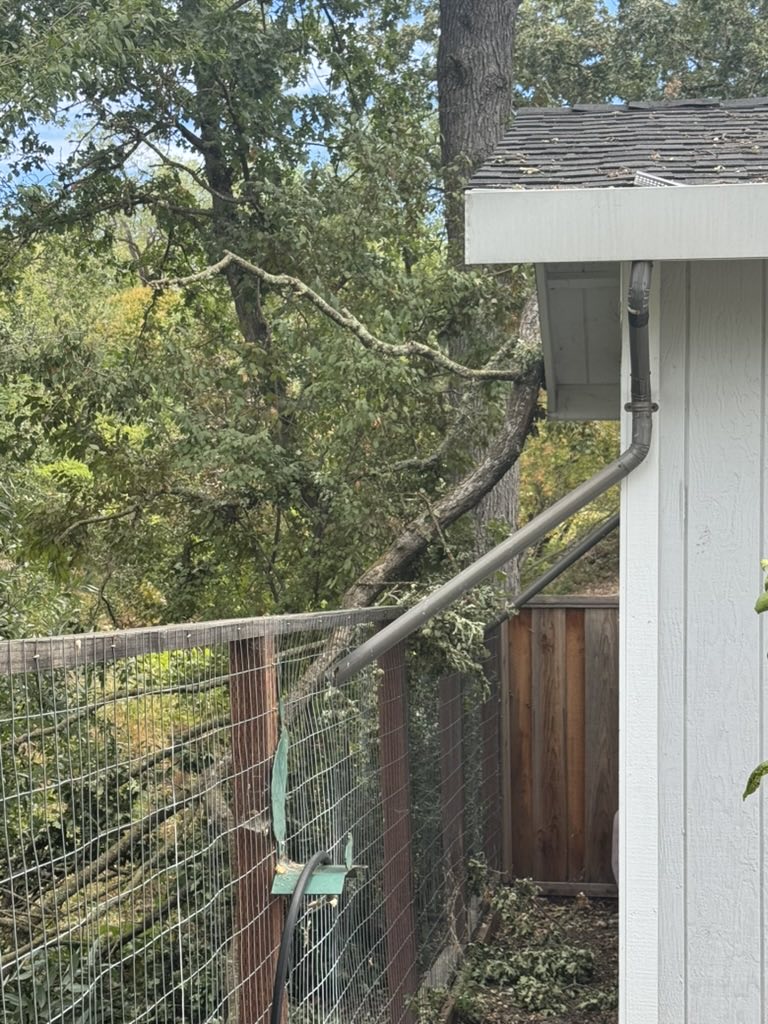 It glanced off the fence and came to rest against my outdoor office, and it was heavy enough that I needed a chainsaw to get it off. A few feet over and I’d have had a hole in that roof. So, would the repair have been covered?
- On the FAIR Plan alone: no. Falling objects isn’t a covered peril, and with no windstorm there is nothing to argue about. The repair is on you.
- On FAIR + DIC: probably, through the DIC side, if your DIC includes falling objects. Most do. But the answer depends entirely on which DIC you bought, and its own deductible applies.
- On an HO3 or HO5: yes. Open-peril coverage picks up a falling limb no matter why it fell. With one catch that surprises people: a detached structure used for business, like a backyard office, is excluded on the standard forms unless you’ve added a business-use endorsement. And business gear inside is typically sublimited to around $2,500. Property you bought personally and use for both work and personal life sits in a gray zone you want settled by endorsement, not argued with an adjuster mid-claim.
Same branch, three very different outcomes. That is the whole point of reading the policy before the tree makes you.
Things that go wrong
The most common mistakes I see in FAIR + DIC stacks:
- No DIC at all. Homeowner ends up on FAIR alone, learns the hard way what isn’t covered. Mortgage lenders may not flag this; they only care that there’s some HO-shaped policy on file.
- Misaligned deductibles. FAIR deductible and DIC deductible don’t coordinate cleanly. Owner ends up self-insuring an unexpected layer in the middle of a claim.
- Coverage limit mismatch. FAIR dwelling limit is below current rebuild cost, DIC doesn’t pick up the difference. Underinsured at the moment of a total loss.
- Lapses between renewals. FAIR and DIC renew on different schedules. Without intentional management, one lapses while the other is in force.
How to think about it
FAIR Plan is a tool, not an answer. For most California homeowners in wildfire country, the right setup is either (a) a specialty surplus-lines HO policy when the home qualifies, or (b) a carefully-built FAIR + DIC stack when it doesn’t. Either way, the work is in matching the home to the right markets and reading the actual policy language, not in picking a path before you know what’s available.
About the author
Tyler Chalk is an independent P&C insurance producer with over two decades of placement experience, including ten years on the founding team at Embroker. He works independently in partnership with Panta. More about Tyler →
Want to talk about your situation?
If your situation isn't one I can help with, I'll tell you that directly.