Resource · Coverage Intelligence
Careful on the Test Drive
A commercial placement case study.
For: Shops that modify customer vehicles, and their advisors
By Tyler Chalk · Published August 27, 2026
An off-road vehicle builder came to me to review their insurance program. The shop takes in trucks, mostly Jeeps, and makes them amazing! We’re talking custom roll bars, lifted suspension, oversized tires, engine work, etc. The roll bars are the exposure that the insurance carriers flagged. They fabricate them in-house and weld them into place - and obviously, a roll bar has exactly one job: when the vehicle rolls over, off-road or on the street, the people inside walk away. If the fabrication fails, they don’t.
Plenty of shops in this space run without coverage for that work. Not because they don’t know better. But because they’ve priced it, decided it’s too expensive, and chosen to carry the risk themselves (or the online quoter didn’t ask about it and the risk is unknown). Customers usually have no idea if the custom work on their car is actually covered - word to the wise: if a shop is welding anything structural into your vehicle, ask whether they carry product liability, or you’re on your own.
This client didn’t want to be that shop. So we built the program properly: general liability, product liability for the fabrication work, and garagekeepers for the customer vehicles in their care, bundled into one coordinated program. It costs more than a standard garage policy, and it should. Welding a safety structure into someone’s vehicle is not standard garage work.
Then we found the gap. When the fabrications/modifications are done, somebody has to drive the truck. You don’t hand back a vehicle with new suspension, new tires, and a welded cage without testing it to make sure everything is doing what it’s supposed to do. But here’s the catch: buried in the policy was an endorsement titled “Operation of Customers Autos on Particular Premises.” Strip away the form language and it says one thing: coverage for driving a customer’s vehicle exists “on or next to” the premises and nowhere else. The lot and the curb. Out on the road where the actual testing happens: not covered. Every post-build test drive was a risk they didn’t know they were taking.
Here’s the exclusion we found, pulled straight from the policy:
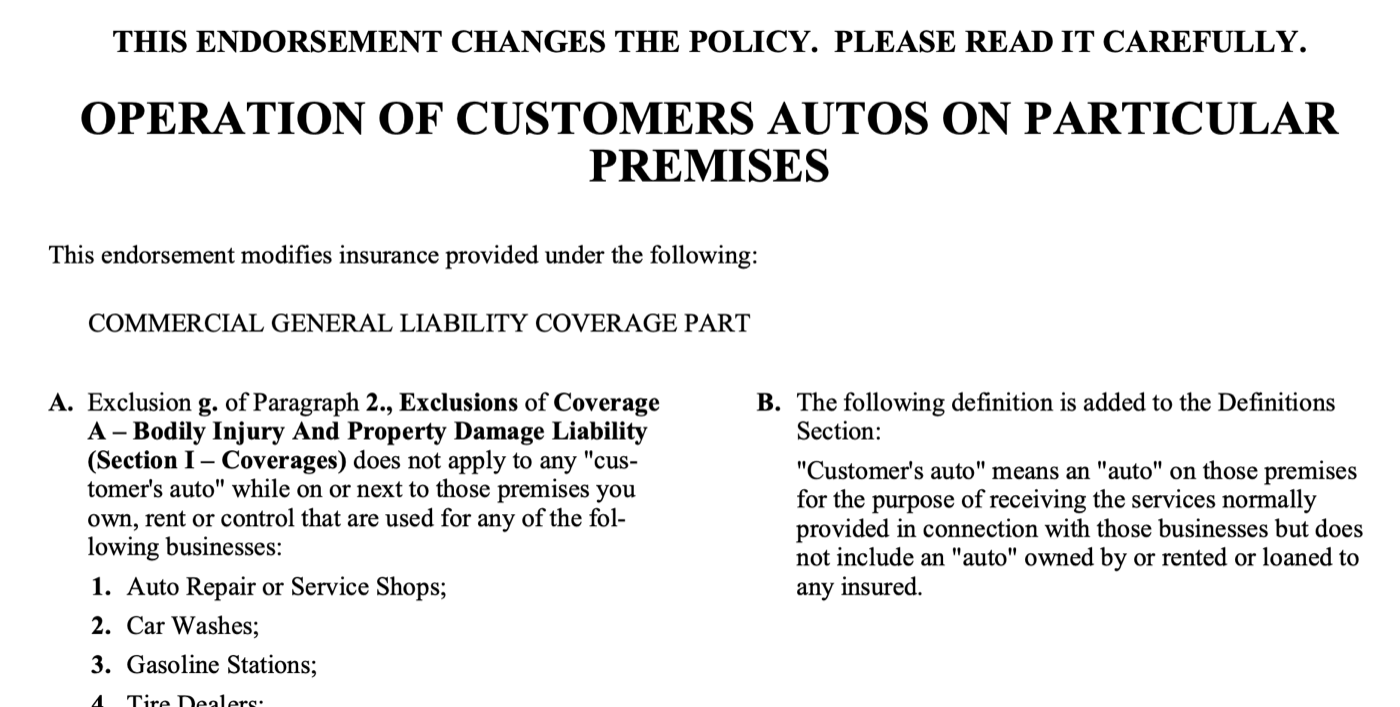
Read it the way an adjuster would. Coverage for a “customer’s auto” stops “on or next to those premises”. And even that applies only to the five listed classes of business; a custom fabrication shop has to hope it reads as an “Auto Repair or Service Shop.” Either way, the road test comes up bare.
We needed to fix this. I went back to the carrier and requested a radius extension up to five miles for a small additional premium. And we had the customer change their intake paperwork. I’m not an attorney, but the concept is simple: every customer now signs an authorization at drop-off permitting the shop to drive the vehicle once the work is done. In California (where this customer is), insurance follows the vehicle, so with the owner’s permission on file, the owner’s own auto policy responds first if something happens on a test drive. The shop’s garagekeepers coverage sits behind it. Two layers of protection where there used to be a gap.
The shop added one more habit on our recommendation: they now ask for a copy of the customer’s auto insurance ID card to confirm coverage limits are legit and in force. California’s minimums doubled in 2025 but are still only 30/60/15. That’s $15,000 of property damage coverage on a policy that might be the first line of recovery for a build worth several times that; if the limits are thin, better to know before the keys change hands.
Here’s the takeaway: gaps like this don’t show up when you just quote. They show up when you understand the operations. We found this one because we talked through the whole risk: how vehicles come in, what happens during the build, and what has to happen before one goes home. That conversation is the key.
About the author
Tyler Chalk is an independent P&C insurance producer with over two decades of placement experience, including ten years on the founding team at Embroker. He works independently in partnership with Panta. More about Tyler →
Want to talk about your situation?
If your situation isn't one I can help with, I'll tell you that directly.